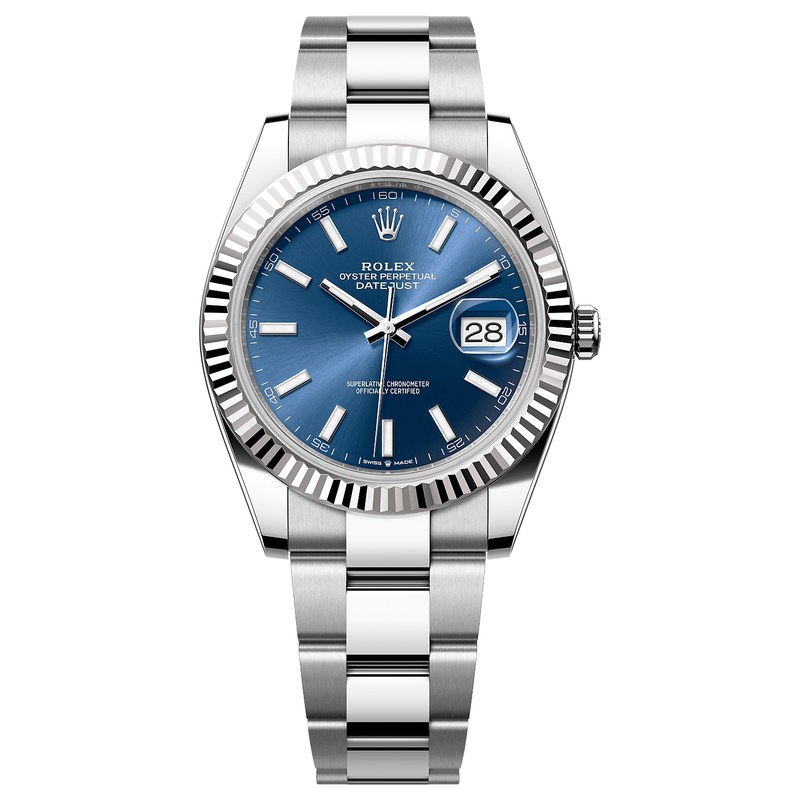
The bread of the saleroom
By Julien Moreau, Geneva ·
Datejusts were the bread of every auction calendar. Every sale had several, nobody fought over them, and they always sold. Consigners would apologise for bringing them in, buyers would pretend to be indifferent, and the hammer would come down at a sensible figure while everyone saved their energy for the Daytonas.
I mention this because it is the Datejust's great virtue. It was introduced in 1945, the first self-winding chronometer wristwatch to show the date in a window on the dial, and in 1953 it acquired the Cyclops lens that magnifies the date and that people have been complaining about ever since. Rolex has changed it so slowly that a Datejust from almost any decade looks right.
The 126334 is the modern 41 mm version with the white gold fluted bezel on a steel case, 11.6 mm thick, a blue dial, the 3235 with 70 hours, a closed back and 100 m. On the bracelet it has the reassuring weight of a well-made object. The fluted bezel throws light in a way that some people find festive and others find a little much in an office.
I have two quibbles. Forty-one millimetres is a big Datejust; the classic size was 36 mm, and on a slim wrist the larger version can look like a man wearing his father's watch. And the Cyclops is still there, still an acquired taste.
At ten thousand fifty to ten thousand five hundred dollars, though, it is one of the few Rolex models you can realistically walk in and buy, and it will hold its value as reliably as anything on the market. For a man who wants one good watch for thirty years, it is a very sound decision. Le pain quotidien, after all, is not nothing.