Blame Paul Newman
By Julien Moreau, Geneva ·
In October 2017, Paul Newman's own Daytona sold at Phillips in New York for a little under eighteen million dollars, and the steel Daytona has been all but impossible to buy at a counter ever since. Or so it feels to anyone who has tried.
It is a long way from where it started. The Daytona arrived in 1963 as a hand-wound chronograph that sold slowly; for years dealers struggled to shift them, which is why the exotic-dial examples are so rare today. Automatic movements based on Zenith's El Primero came in 1988, Rolex's own calibre in 2000, and the black ceramic bezel on the steel model in 2016. The 2023 update brought the 4131, with 72 hours of reserve, and some subtle refinements to the case and dial that only specialists will notice and that they will discuss at tedious length.
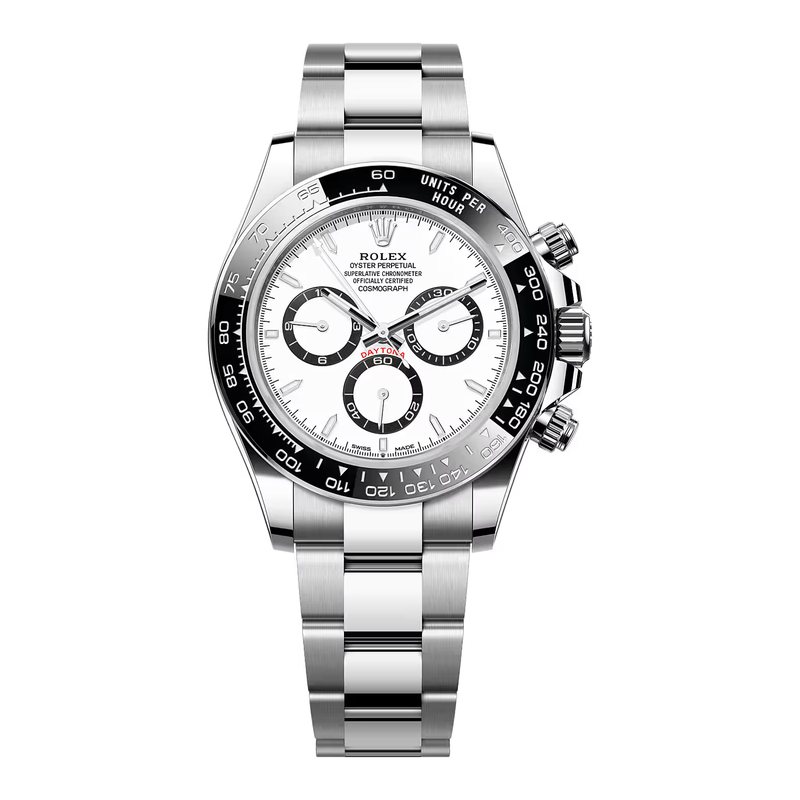
This one has the white dial with black counters, the so-called panda, which I think is the correct choice: the best-looking modern Rolex dial and the one most clearly descended from the 1960s. The case is 40 mm by 12.2 mm, with screw-down pushers, a closed back, 100 m of water resistance, and the Oyster bracelet. It wears smaller and slimmer than you would expect from a chronograph.
My criticism is not of the watch, which is excellent. It is of the theatre required to get one. Fifteen thousand to sixteen thousand dollars is the list price, and it is a fair price. Paying that figure, however, usually requires a purchase history, a good relationship and a willingness to buy things you did not want, while the secondary price is something else again. The whole performance strikes me as rather vulgar. Quel cirque.
Should you buy one? If your boutique offers it to you at list, yes, without hesitation, and wear it. If you are being asked to pay a large premium, I would look at a Zenith Chronomaster Sport and a good dinner. Newman, for what it is worth, wore his on a strap, apparently paid it no attention whatsoever, and gave it away.