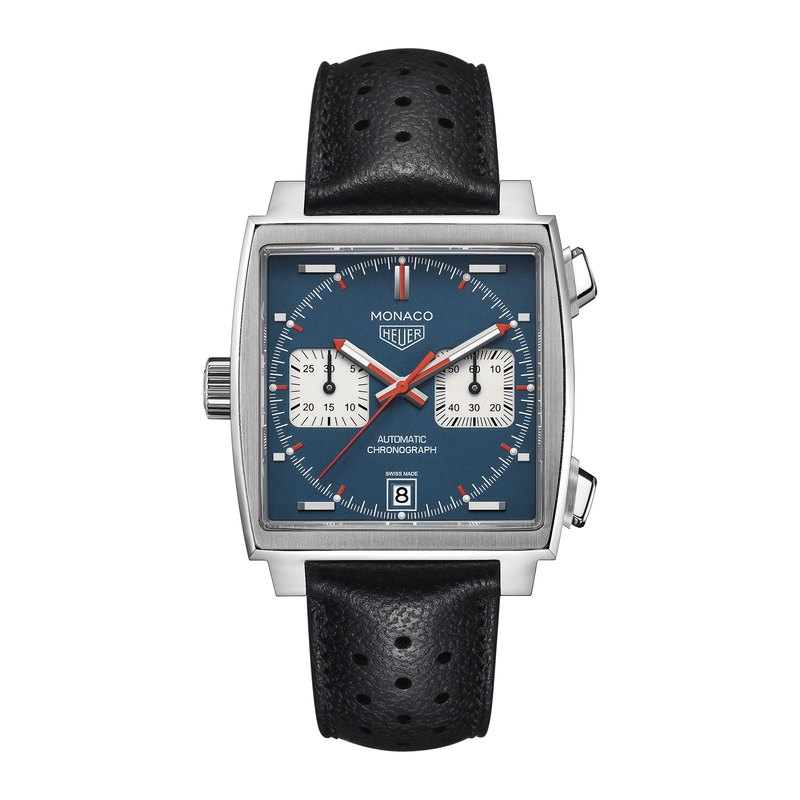
The crown belongs on the left
By Julien Moreau, Geneva ·
Everyone mentions Steve McQueen, so let us get him out of the way: Le Mans, 1971, Gulf racing suit, a blue Monaco. There. It is a wonderful image and it has sold more Monacos than any advertisement.
The more interesting history is the movement. The Monaco appeared in 1969 as one of the very first automatic chronographs, powered by the Calibre 11 Chronomatic, developed by Heuer with Breitling, Hamilton-Büren and Dubois-Dépraz in the race against Zenith and Seiko. The movement used a micro-rotor and a modular chronograph, and the crown was placed on the left, as a signal that you no longer needed to wind it. That left-hand crown is the detail Monaco collectors care about most.
This modern Calibre 11 keeps it. The square steel case is 39 mm across and 14 mm thick, the blue dial is the McQueen colour, with a date, the open back shows the automatic movement, and it is water resistant to 100 m on a leather strap. It is the version closest in spirit to the 1969 watch.
A few objections, then. Forty hours of reserve is modest, and 14 mm is a thick watch, which you notice more on a square case than a round one. The modern movement is also not the original architecture, and anyone who has handled a 1969 Monaco will feel the difference.
At sixty-nine fifty to seventy-four fifty, it is the Monaco I would choose, and the left crown is the reason. If you prefer a better movement, the Heuer 02 is there. I prefer history.