If I could only keep one
By Sam Okafor, London ·
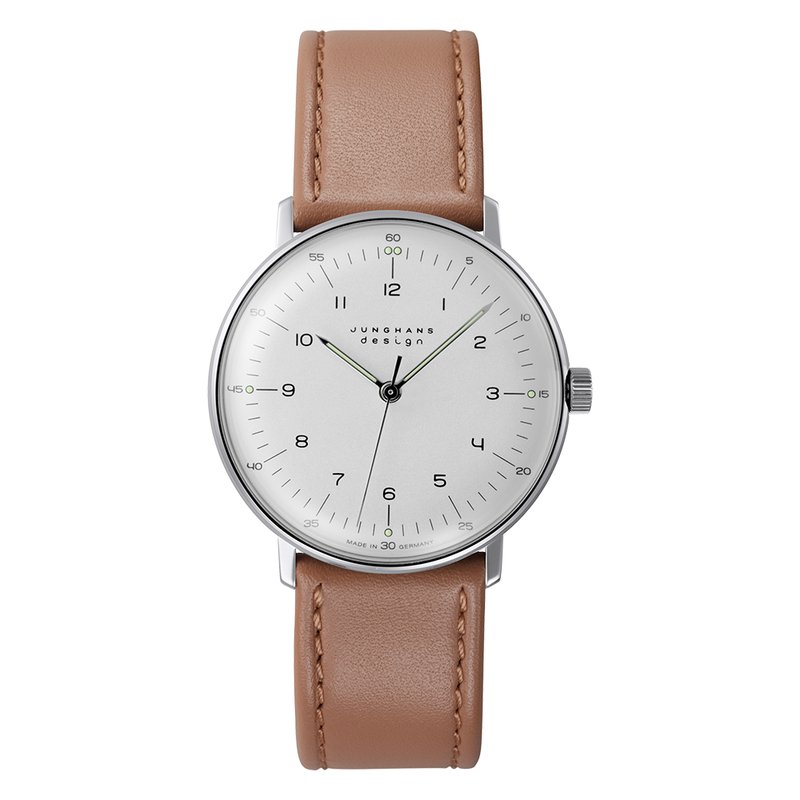
This is the watch I'd hand to someone who asked what I mean when I talk about proportion. 34 mm across, 8.6 mm thick, a silver dial, slim hands and a small set of thin numerals. That's very nearly all of it. No date, no logo fireworks. And yet it's never boring, because every decision on it has been considered.
Start with the numerals. They're a narrow, slightly condensed sans that feels contemporary with Helvetica without being Helvetica, and they sit inside a minute track of fine strokes. The hour hand stops short of the numerals by a gap that's almost exactly the width of the numeral stroke itself. I don't know if that's deliberate, but it reads as deliberate, which in design is what counts.
Then the crystal. It's acrylic, domed high, and it makes the dial look as if it's sitting under a drop of water. Light runs round the edge of the dome and distorts the outer minute track very slightly when you tilt your wrist. Sapphire would be more practical. It would also be flatter and colder, and the watch would lose half its charm. I'll take the scratches and a tube of Polywatch.
The case is a simple drum with thin wire lugs and 17 mm between them, which suits a narrow strap and a narrow wrist. At 34 mm some people will call it small, and they're right, by the standards of the last twenty years. By the standards of the 1960s, when this design was drawn, it's perfectly normal. Wear it with a cuff and nobody will see it until you choose to show them.
It also wears in a way photographs never show. The lugs are short and thin, and they curve down just enough to keep the case close to the wrist, so the watch looks like a small round window set into the strap rather than an object perched on top of it. Put it next to a modern 41 mm sports watch and the difference is like comparing a Wegner chair with a recliner: one is drawn, the other is upholstered.
Practical notes: hand-wound, 42-hour reserve, 30 m, an open caseback. You'll wind it every morning, which I've always thought is part of the point. Rivals at 850 to 950 dollars? There aren't many that are this carefully drawn. The Nomos Tangente is the obvious one, and it's better finished, but it costs twice as much.
Who shouldn't buy it: anyone who wants a date, a bracelet, or something that announces itself across a room. Everyone else should at least try one on.